


The client
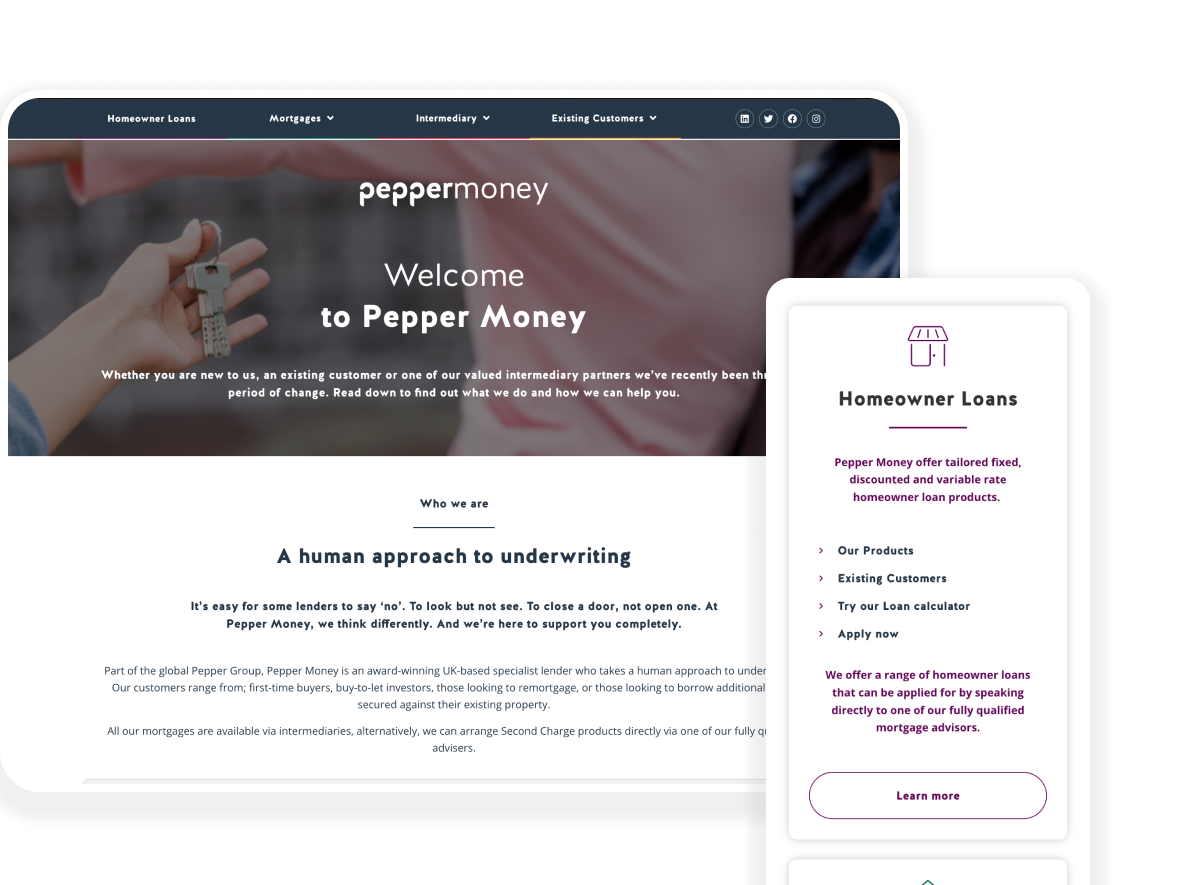
Pepper Money is a UK specialist mortgage lender serving customers and brokers across a range of residential and buy-to-let products. Their digital presence isn’t just a marketing asset; it’s operational infrastructure. Brokers use sourcing systems that pull from lender websites in real time to compare and recommend products. So when Pepper Money’s site is slow, difficult to update, or unreliable, brokers feel it immediately.
The constraints
When Marcus Taylor, Head of Digital and UX, came to us, Pepper Money’s WordPress site was hosted internally by their platform team. In principle, that setup worked. In practice it made publishing anything, including product updates, structurally difficult.
Every deployment required the full digital team plus a platform engineer on hand, in case something needed rolling back. Migrations from staging to live took up to an hour and were unreliable; it wasn’t unusual for a migration to run for fifty minutes and then fail. Because of the resource required, the team had to be selective about when they could deploy anything. Blog posts, marketing campaigns, SEO updates, they all had to be bundled into product release windows rather than published when the business needed them.
In a volatile mortgage market where product pricing changes frequently and competitors move fast, that kind of pipeline isn’t just inconvenient. It’s a strategic constraint.
“We were stuck in a linear pipeline where we had to be very frugal with releases,” Marcus explains. “We needed to move a lot quicker.”
Finding Illustrate Digital
Pepper Money came to us through recommendation. They carried out due diligence on several potential partners before making their decision, but two things gave us an edge: a strong reputation in their sector, and our partnership with WP Engine.
For a regulated financial services business, hosting reliability isn’t a preference; it’s a requirement. Brokers depend on the site being available. The security credentials and environment stability that WP Engine provides spoke directly to what Pepper Money needed, and that came through clearly in the scoping conversations.
Marcus is honest that there was natural anxiety about moving business-critical infrastructure to a new supplier. That’s a reasonable response when your website is as operationally important as Pepper Money’s. It’s also, as it turned out, exactly the kind of concern our migration process is designed to address.
The migration
We managed Pepper Money’s migration to WP Engine, maintaining the existing regulated approval process in staging throughout. For a financial services business, the sign-off process isn’t optional; content needs to be approved by the relevant stakeholders before it goes live. Our job wasn’t to remove that process. It was to remove the overhead that had built up around it.
The results were immediate.
Deployment time dropped from up to an hour to ten minutes. That’s an 83% reduction, and unlike the old setup, those ten minutes were reliable. The team no longer experienced migrations that stalled and failed after running most of the way through.
More significantly, any single member of the digital and UX team could now carry out a deployment independently. The need to coordinate multiple people around a single publishing event disappeared. New environments could be spun up on demand rather than through an IT ticket queue. Automated backups meant that rollbacks, when needed, were fast and straightforward.
“It used to take us up to an hour to migrate from one environment to another,” says Marcus. “That was down to ten minutes with Illustrate and WP Engine, and that’s a full site migration. Rather than needing effectively the whole team present plus a member from the platform team, any one of us could do a migration on our own.”
The impact
The operational shift was significant on its own terms, but the real value was what it unlocked. With the pipeline constraint removed, Pepper Money could begin publishing at the pace the business actually needed. Content could go out when it was ready. Marketing campaigns could launch on schedule. SEO work could move at speed. The team had the autonomy and the tooling to run the website properly, rather than working around its limitations.
The regulated sign-off process remained exactly as it should be. The time and resource cost of honouring it dropped dramatically.

“What’s impressed me most about working with Illustrate Digital is how naturally the relationship has adapted to our changing needs. We started with a fundamental infrastructure problem, and they solved it. As our focus shifted to UX and performance, they shifted with us. Four years in, they’re still filling the gaps that matter most to us at any given time. That kind of flexibility is genuinely rare in an agency partnership.”
What came next
The migration was the start of a relationship, not the end of one. Over the following four years, our work with Pepper Money evolved considerably, from infrastructure to UX, from search to product tables to data-led improvement. The full story of that partnership is told in our main Pepper Money case study.
Thinking about making a similar move? Read more about our approach to agency migrations, or get in touch to talk through your situation.
Explore similar case studies
Learn about our impact with brands similar to Pepper Money. Explore our other case studies and how we add value to our clients through strong relationships, growth retainers and projects.
Burges Salmon —
building a client-led legal experience
Learn about how Illustrate Digital built and maintains a dynamic, client-led legal experience for one of the UK’s top 50 law firms using the WordPress CMS.
Read Case Study
GoCompare —
Pioneers in consumer price comparison
Learn how we’ve helped to fine-tune the user journeys for one of the world’s leading comparison brands.
Read Case Study
Countingup Bank —
Building the bank you can count on
Our team were asked to help Countingup take their established website user experience to a new level.
Read Case Study